try_lock_guard, lock_guard and no_lock_guard provide a way to design policies that are not bases just on object or class locking, but fine-grainedly control wether some internal construct should have exclusion, probabilistic exclusion or no exclusion at all. More...
#include <threads.hpp>
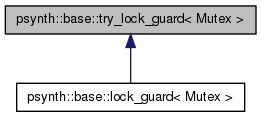
Inheritance diagram for psynth::base::try_lock_guard< Mutex >:
Public Types | |
| typedef std::unique_lock< Mutex > | guard_type |
Public Member Functions | |
| guard_type | default_guard () |
| template<typename... Args> | |
| guard_type | guard (Args...args) |
| void | lock () |
| bool | try_lock () |
| void | unlock () |
Detailed Description
template<class Mutex = std::mutex>
struct psynth::base::try_lock_guard< Mutex >
try_lock_guard, lock_guard and no_lock_guard provide a way to design policies that are not bases just on object or class locking, but fine-grainedly control wether some internal construct should have exclusion, probabilistic exclusion or no exclusion at all.
Member Typedef Documentation
template<class Mutex = std::mutex>
| typedef std::unique_lock<Mutex> psynth::base::try_lock_guard< Mutex >::guard_type |
Reimplemented in psynth::base::lock_guard< Mutex >, and psynth::base::lock_guard<>.
Member Function Documentation
template<class Mutex = std::mutex>
| guard_type psynth::base::try_lock_guard< Mutex >::default_guard | ( | ) | [inline] |
Reimplemented in psynth::base::lock_guard< Mutex >, and psynth::base::lock_guard<>.
template<class Mutex = std::mutex>
template<typename... Args>
| guard_type psynth::base::try_lock_guard< Mutex >::guard | ( | Args... | args | ) | [inline] |
template<class Mutex = std::mutex>
| void psynth::base::try_lock_guard< Mutex >::lock | ( | ) | [inline] |
template<class Mutex = std::mutex>
| bool psynth::base::try_lock_guard< Mutex >::try_lock | ( | ) | [inline] |
template<class Mutex = std::mutex>
| void psynth::base::try_lock_guard< Mutex >::unlock | ( | ) | [inline] |
The documentation for this struct was generated from the following file:
- /home/raskolnikov/dev/psynth/trunk/src/psynth/base/threads.hpp